Monday, January 17, 2011

Gun Control Is A Failure

Gun Control Is A Failure


This editorial statement is in response to this New York Times editorial entitled "Gun Crazy", published March 1, 2008. The NYT editorial missed the point so badly, I finally had to challenge their core belief in gun control as a public policy. I don't expect this will be published by the NYT, but I provide it here for your review.


As a public policy, so-called gun control is a failure.

The landmark legislation for gun control was the 1968 Gun Control Act which politicians hailed as "sensible" gun control. We were told that it would reduce crimes with firearms and give police the tools they needed to track down criminals. Yet, every year we see increasingly complex restrictions on firearms while crimes with guns continues unabated. Each of these new laws is touted, just like in 1968, as providing police "the tools they need" or they are proclaimed "common sense" measures. In several areas of the country it is nearly impossible to legally obtain a handgun, yet there is no shortage of them available to street gangs and common criminals.

If gun control as a public policy worked at all, we would have lower rates of crimes with guns than in 1968. But, we do not. I think forty years is enough time to prove the theory of "gun control" just doesn't work. As a public policy, it is a failure.

None of these restrictive laws, which now number over 20,000 laws nationwide, have shown, either individually or collectively, any significant impact on crimes committed against people or even crimes committed with guns in general.

A government report showed that the so-called "Brady Bill," touted as a "significant step" in reducing gun crimes, had no measurable effect on crime. We have also seen how the so-called "gun free zones" have turned school campuses into defenseless-victim killing zones.

"Yes, but..." begins the Gun-Control lobby when they go on the defensive. They will tell you that existing laws didn't go far enough or that the laws were compromised in legislative sessions. They'll tell you that if only they could enact comprehensive control - either an outright ban or a court's permission to have a gun - the numbers would show they are right.

Great Britain has, since 1997, had a ban on almost all firearms, especially handguns. Yet, as the 20th Century closed, the UK quietly began arming it's famous "Bobbies" with guns for the first time in over 100 years. One story in the British media described the "gun problem" by saying that in the last ten years there have been more reported gun crimes than in the thirty years before the ban. Our own Washington D.C. banned handguns and operational long guns in the home back in 1976. Since that time, the Capitol's murder rate has been the highest, or one of the highest, in the country. So much for a utopian gun control example.

Only one set of laws shows any appreciable statistical impact on personal crimes. Not too surprisingly, these laws are not restrictive, but liberally permissive in the classical sense. These laws allow citizens with clean records to legally carry concealed firearms after taking the state mandated training. While restrictive "gun control" laws do little or nothing to impact crimes against people, these "shall-issue" concealed carry laws can be shown reduce such crimes.

Why? Because criminals are no longer certain their victims are defenseless. A victim who fights back is fighting for their life, which the criminal threatens in robbery, rape and other crimes. And, they fight to win. With these laws it the criminal who is at a disadvantage, not the citizenry. A 1985 study by the National Institute for Justice shows criminals fear the armed citizen more than they fear the police.

So, what should we be asking our legislators to do? We should be tell them to focus on controlling criminal behavior instead of trying to control access to inanimate objects.

We should also make it clear that criminals can not profit from their illegal actions should they be injured during a crime. If they step "outside the law" by instigating the crime, they waive their rights to civil suits against their victims. To further discourage repeat offenders we should mandate maximum sentencing with no parole after a third conviction to keep the serious criminals off the street.

The Gun-Control Lobby continues to push against a door marked "pull", never quite realizing that even after 40 years, pushing just isn't going to open the door. At least, not until they realize they have been pushing in the wrong direction.


Gun Control - Require Licenses or Not?

Gun Control - Require Licenses or Not?


Start talking about gun control and someone invariably says, "Well, we license cars, boats and planes, and we require people to get licenses for those. Why not for guns too?"

Well, why not?
Simple. Because it's illegal to do so. Unless or until the United States Supreme Court decides that individuals do not have the Constitutional right to own or possess guns, then any law requiring licenses will likely be ruled unconstitutional.

The Bill Of Rights

The Bill Of Rights, the first ten amendments to the U.S. Constitution, are considered to be a collection of rights guaranteed to the people on which the government cannot intrude. The court has ruled that it sees the words the people in the bill of rights referring to all of the people of the United States and that it is the same "people" referred to in the First (free speech, worship, press) as in the Fourth (searches, warrants) and Fifth (speedy trial, self-incrimination) as in the Second (right to arms).

Additionally, the Supreme Court has held that the government may not require a license to exercise a right. For example, the government may not require people to have a license to practice free speech, or to attend a church. Likewise the government may not require record keeping of those who practice a right or those who participate. Like the post-civil war era poll tax levied on blacks to prevent them from voting, the government may not require the people to pay any fees or taxes to exercise a right. This does not mean that any right is free from regulation or fees however. But the basic right must be unfettered. Claiming the government can't make you pay for a FCC license for a radio or TV station won't work, simply because the Court will remind you that you can retreat to a soap box or print up leaflets (or Web Pages!) and still exercise your right to free speech.

Comparing Cars to Guns

You do not have a right to own a car, or to drive one. There is no constitutional guarantee for you to own or possess an automobile, truck, car, motorcycle, bicycle or even a skateboard. If any of these products were deemed to be illegal you would have no constitutional challenge under the Bill of Rights (except, perhaps, that of due-process before you must give up your vehicle).

With that out of the way, let's do a little comparison. First, let's think about registering guns like cars and licensing gun owners like car drivers. In the first place we'll have to purge a lot of useless laws off the books regarding firearms. Consider:

  • There is no waiting period to purchase an automobile.
  • Anyone can purchase an automobile as long as they can sign a legal contract to pay for it.
  • You are not required to lock up your car and keep it away from children.
  • People convicted of felonies or domestic violence can own an automobile.
  • Anyone paying cash can purchase an automobile, even if they're under 18.
  • You do not have to have a driver's license to buy an automobile.
  • The government does not have the power to inspect how you garage your car.
  • There is no limit how many cars you can own, or how many you can buy per month.
  • The government can't limit the features of your car, such as top speed, fuel capacity, horsepower, etc.
  • The government does not limit how many gallons of gas you can buy per month.
  • The only penalty for not registering your automobile yearly isn't a felony.
  • The government, except for a few states, cannot seize your automobile if you fail to register it.
  • You only need to register an automobile if you plan to use it on the street.
  • To obtain a driver's license you fill out a written test, provide a birth certificate (and/or INS papers), take an eye exam and a short driver's test to show you can operate the vehicle.
  • The fee for a license ranges from about $5 to $20.
  • Licenses are good for several years, some states renew automatically; others are lifetime licenses.
  • Licenses are only revoked after a court trial for misuse or violating the laws.
Are you still enthusiastic about it? You can see how many so called "gun-control" laws would be abolished by such a scheme. But we have not considered the opposite side of this question. Since you don't have a right to an automobile, the government can impose many laws on their ownership, purchase and use that cannot be applied to guns. But let's stick with guns for the moment and see what you'd have to go through.

Registering and Licensing Cars like Guns
  • Convicted felons could not own or drive a car.
  • You'd pay for a car, register it and then wait from 5 to 15 days to pick up your car.
  • Purchasing a used car from a neighbor requires the same waiting period and you would have to transact the sale through a licensed car dealer.
  • You could buy a car, register it but you'd need a special permit to take in on the streets.
  • To get the above "street permit" you have to show good cause and be of good moral character.
  • Persons convicted of "domestic violence" could not own or drive a car, even if that occurred 30 years ago.
  • Cars have to be stored where no child could access it and hurt themselves playing with it.
  • In some places (e.g. NYC or New Jersey) you would first need a permit to buy from the police department which sometimes takes up to 2 years to obtain.
  • If you own more than a certain number of cars, the government could enter your home at any time to ensure you stored your cars properly. This is actually a proposed law by Handgun Control, Inc. that would require anyone owning more than 4 guns to have an "arsenal" license and permit warrantless searches.
  • If a minor child stole your car and hurt himself or others with it, you'd be guilty of a felony.
  • In some cities (e.g. Washington D.C.) you would have to store your car partially disassembled.
  • Failure to register your car would be a federal felony (prevents you from owning another one).
  • People under psychiatric care or mentally incompetent could not own or drive a car.
  • Some models of automobiles might be banned after you buy them and you'd have to turn them over to the government without compensation.
  • "Assault vehicles" look evil and must be specially registered at extra cost. Hummers, 4x4 trucks, Suburbans, Dodge Vipers, Nissan NSX's, and Corvettes are likely targets.
  • Cars under a certain size or having certain features could not be imported.
  • You could not modify your car to allow more fuel, more performance, or better cornering.
  • The government would allow some states or cities to not issue licenses at all, for any reason.
  • Cars could not be operated on city streets with gasoline in the tank. (Kinda defeats the whole purpose, doesn't it?)
  • In some states (e.g. Virginia, California) you could only buy one car per month.
  • There would be no traffic "infractions", all violations would be misdemeanors or felonies.
  • It would be illegal to directly buy a car from an out of state dealer or seller.
  • Car dealers would have to allow government agents to review their records without a warrant and without notice.
  • Car dealers who sell a car to someone prohibited would be charged with a federal felony.
  • Car dealers would be subject to being shut down by the government for failure to keep proper records and charged with a felony.
  • The inventory of car dealers could be seized and destroyed before a conviction was obtained.
This all sounds pretty silly, doesn't it? Most of these are gun-laws, applied to autos or drivers.

To destroy a right, you first have to control it!

The first step in destroying a right is to control that right and make its use subject to government regulation and/or taxation. Sen. Daniel Patrick Moynihan claimed that the government could tax guns and/or ammunition out of existence. Though I have a feeling that the Supreme Court would rule that plan an infringement on the exercise of that right, just as the poll tax infringed on the voting rights of the post civil war blacks. Imagine the outraged cry from the media if Moynihan proposed that people had to pay a $1500 tax each time they hired a lawyer - in essence, making you pay the government a royalty-fee for exercising your right to a lawyer for a criminal trial.

A license is permission from an authority to do something unusual or otherwise restricted by law. A right is something you have, like breathing, that the government does not give you. According to historical reviews, religious texts and our founding fathers, the right to resist a tyrannical government exists in all free men, as well the right to arms for the purposes of survival, defense of self and of the state. Don't be fooled by the way gun-control people twist the meaning of things however. The Constitution does not grant a right to keep and bear arms because that right pre-dates the Constitution and all other laws of men! The Second Amendment limits the power of the government to restrict or infringe on the right of its people to keep and bear arms!!

Once the government can require a license for you to practice a "right", then that right can also be denied to you by regulations, created by non-elected bureaucrats, to restrict your rights until it is impossible to obtain a license. Another way is to make the licensing procedure and paperwork so onerous that no one would want to obtain a license.

Could We License Other Rights?

Imagine for a moment the hue and cry from the media if the government proposed that all journalists be licensed! Or that a journalist could only write one article per month. Or that a journalist who was an ex-felon had to find another line of work? Why not? We prohibit felons from holding office, don't we? Could the government require that anyone publishing any material reaching over 20 people to get a business license as a "publisher"? That would subject them to other bureaucratic laws and regulations.

What if the government required all clergy members to register their parishioners when they attended church? What if the government required you to get a permit to publish a web page? How about the government requiring publishers to turn over all subscription lists? Or having to register your purchase of a newspaper or magazine?

Do I hear you saying you have a right to those things?

"...we wrote a fairly radical Constitution with a radical
Bill of Rights, giving a radical amount of individual
freedom to Americans ...... And so a lot of people say
there's too much personal freedom. When personal freedom's
being abused, you have to move to limit it.

   -- U.S. President Bill Clinton, on MTV 3-22-94

Taking On Gun Control

Taking On Gun Control

Flag1


"I have sworn upon the altar of God, eternal hostility against every
form of tyranny over the mind of man." --Thomas Jefferson


A Well-Organized and Armed Militia

"For a people who are free and who mean to remain so, a well-organized and armed militia is their best security. It is, therefore, incumbent on us at every meeting [of Congress] to revise the condition of the militia and to ask ourselves if it is prepared to repel a powerful enemy at every point of our territories exposed to invasion... Congress alone have power to produce a uniform state of preparation in this great organ of defense. The interests which they so deeply feel in their own and their country's security will present this as among the most important objects of their deliberation."
--Thomas Jefferson: 8th Annual Message, 1808. ME 3:482
"None but an armed nation can dispense with a standing army. To keep ours armed and disciplined is therefore at all times important." --Thomas Jefferson, 1803.
"It is more a subject of joy [than of regret] that we have so few of the desperate characters which compose modern regular armies. But it proves more forcibly the necessity of obliging every citizen to be a soldier; this was the case with the Greeks and Romans and must be that of every free State. Where there is no oppression there can be no pauper hirelings." --Thomas Jefferson to James Monroe, 1813.
"A well-disciplined militia, our best reliance in peace and for the first moments of war till regulars may relieve them, I deem [one of] the essential principles of our Government, and consequently [one of] those which ought to shape its administration."
--Thomas Jefferson: 1st Inaugural, 1801.
"[The] governor [is] constitutionally the commander of the militia of the State, that is to say, of every man in it able to bear arms." --Thomas Jefferson to A. L. C. Destutt de Tracy, 1811.
"Uncertain as we must ever be of the particular point in our circumference where an enemy may choose to invade us, the only force which can be ready at every point and competent to oppose them, is the body of neighboring citizens as formed into a militia. On these, collected from the parts most convenient, in numbers proportioned to the invading foe, it is best to rely, not only to meet the first attack, but if it threatens to be permanent, to maintain the defence until regulars may be engaged to relieve them."
--Thomas Jefferson: 1st Annual Message, 1801. ME 3:334


Every Citizen a Member of the Militia

"We must train and classify the whole of our male citizens, and make military instruction a regular part of collegiate education. We can never be safe till this is done."
--Thomas Jefferson to James Monroe, 1813.
"I think the truth must now be obvious that our people are too happy at home to enter into regular service, and that we cannot be defended but by making every citizen a soldier, as the Greeks and Romans who had no standing armies; and that in doing this all must be marshaled, classed by their ages, and every service ascribed to its competent class."
--Thomas Jefferson to John Wayles Eppes, 1814.

On Civil Rights


The Right to Bear Arms

In a nation governed by the people themselves, the possession of arms to defend their nation against usurpers within and without was deemed absolutely necessary. This right was protected by the 2nd Amendment.
"The constitutions of most of our States assert that all power is inherent in the people; that... it is their right and duty to be at all times armed."
--Thomas Jefferson to John Cartwright, 1824.
"One loves to possess arms, though they hope never to have occasion for them."
--Thomas Jefferson to George Washington, 1796. ME 9:341
"A strong body makes the mind strong. As to the species of exercises, I advise the gun. While this gives a moderate exercise to the Body, it gives boldness, enterprise, and independence to the mind . . . Let your gun therefore be the constant companion of your walks."
--Thomas Jefferson, Letter to his nephew Peter Carr, August 19, 1785.
"No freeman shall be debarred the use of arms (within his own lands or tenements)."
--Thomas Jefferson: Draft Virginia Constitution with (his note added), 1776. Papers, 1:353
"Laws that forbid the carrying of arms . . . disarm only those who are neither inclined nor determined to commit crimes . . . Such laws make things worse for the assaulted and better for the assailants; they serve rather to encourage than to prevent homicides, for an unarmed man may be attacked with greater confidence than an armed man."
--Thomas Jefferson, quoting Cesare Beccaria in On Crimes and Punishment (1764).


Second Amendment References
Thomas Jefferson On The Right To Keep And Bear Arms  chk
Semantic Analysis of the 2nd Amendmentchk
The Embarrassing 2nd Amendment
States also Guarantee Gun Ownershipchk
United States Senate Second Amendment Report
Quotes on the Right to Keep and Bear Armschk
 
Links, Comments and Feedback
Links to other sources 
Other Right To Keep And Bear Arms websites 

Ten Commandments of Firearms Safety

Ten Commandments of Firearms Safety

  1. Always keep the muzzle pointed in a safe direction.
  2. Treat every firearm as though it were loaded.
  3. Always make sure the firearm is unloaded and keep the action open except
    when actually hunting or preparing to shoot.
  4. Be sure the barrel and action are clear of obstruction and that you have
    the proper ammunition for the firearm you are carrying.
  5. Be sure of your target before you pull the trigger.
  6. Never point a firearm at anything you do not want to shoot. Avoid all horseplay
    with any firearm.
  7. Never climb a fence, tree, or jump a ditch with a loaded firearm.
  8. Never shoot at a flat hard surface or water.
  9. Store firearms and ammunition separately.
  10. Avoid alcohol and other [unnecessary] drugs before or during shooting.

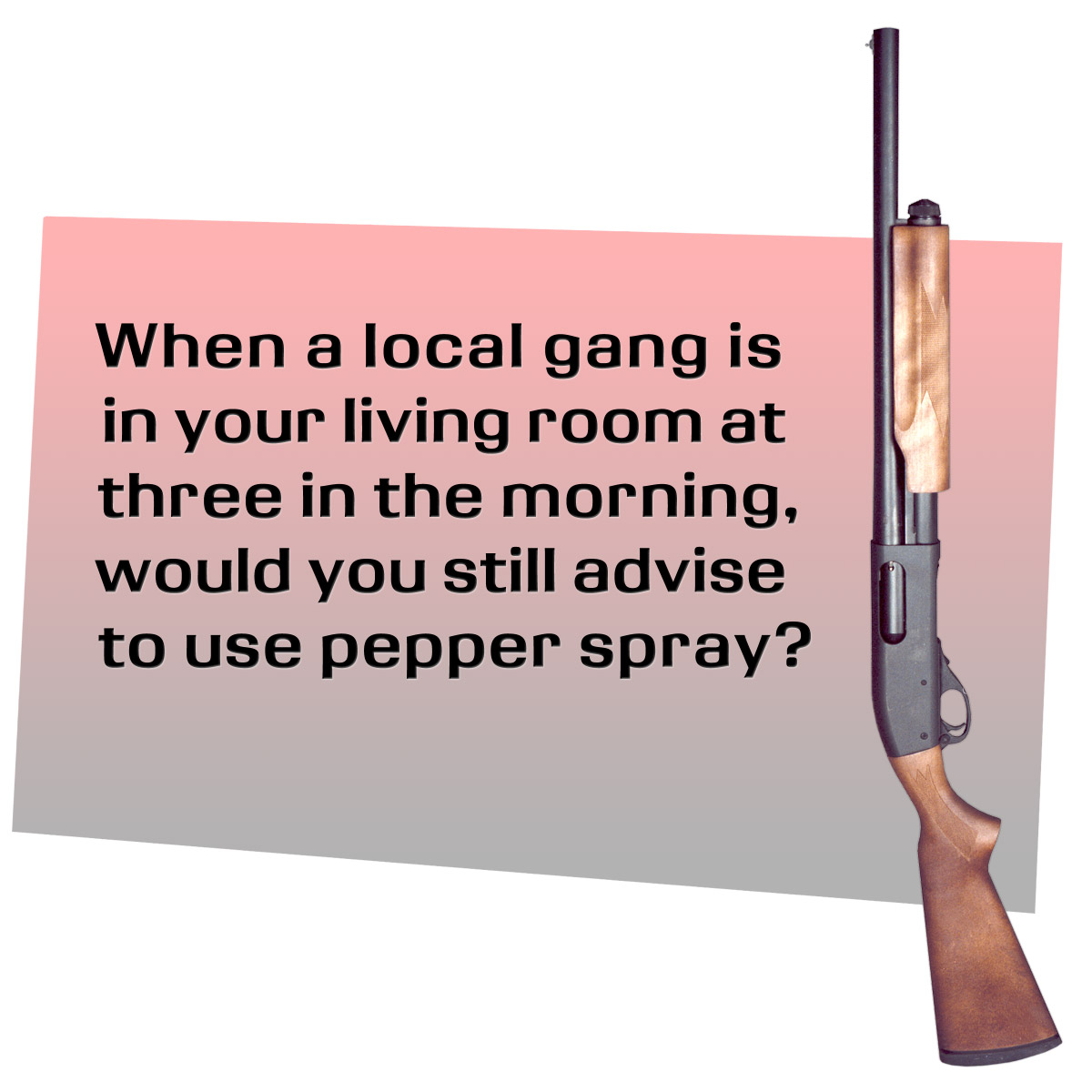
When a threat to your safety comes from a hostile human

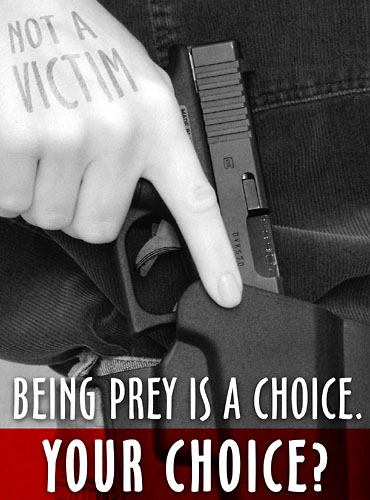
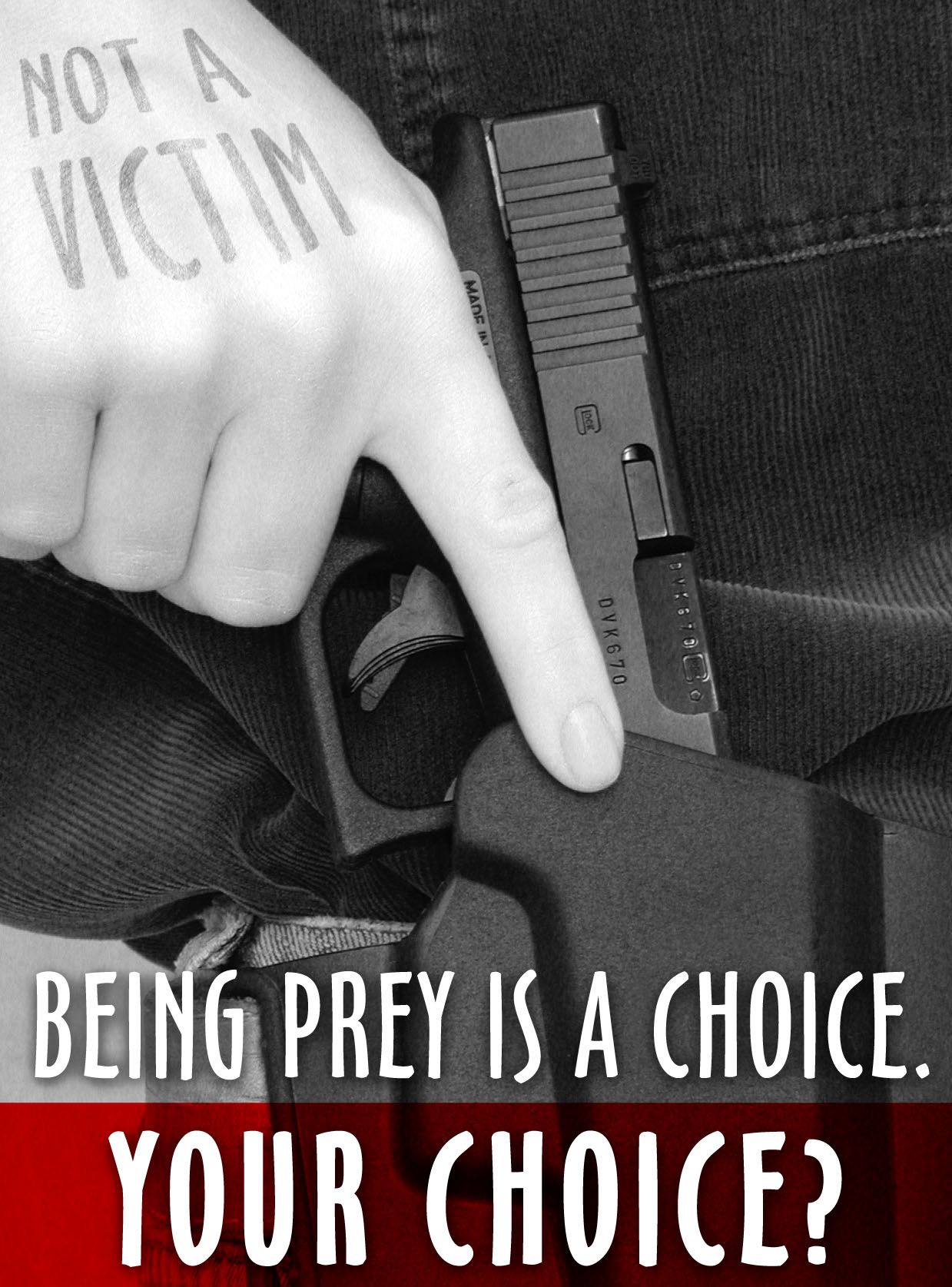
choose to be prey?
Hi-res
Since some division of labor is necessary, some people choose to delegate the task of assuring personal safety to others. Such view is akin to saying: "I won't brush my teeth. That's what my dentist is for."
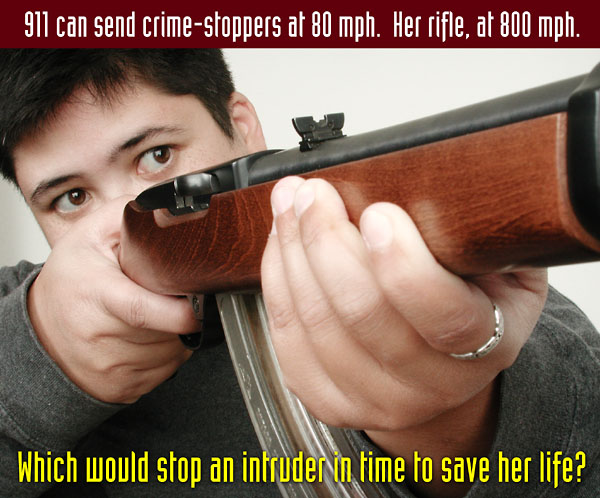
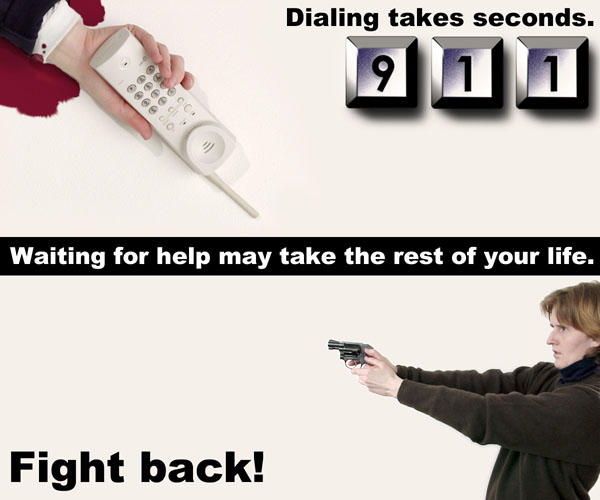
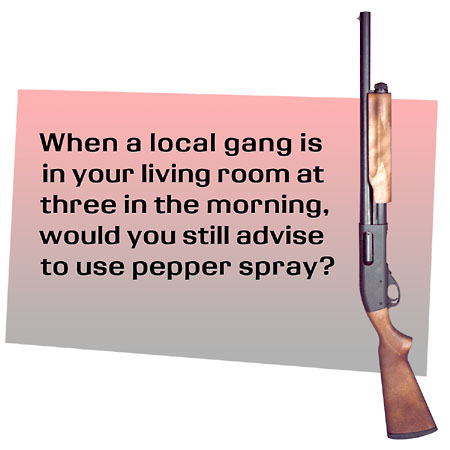
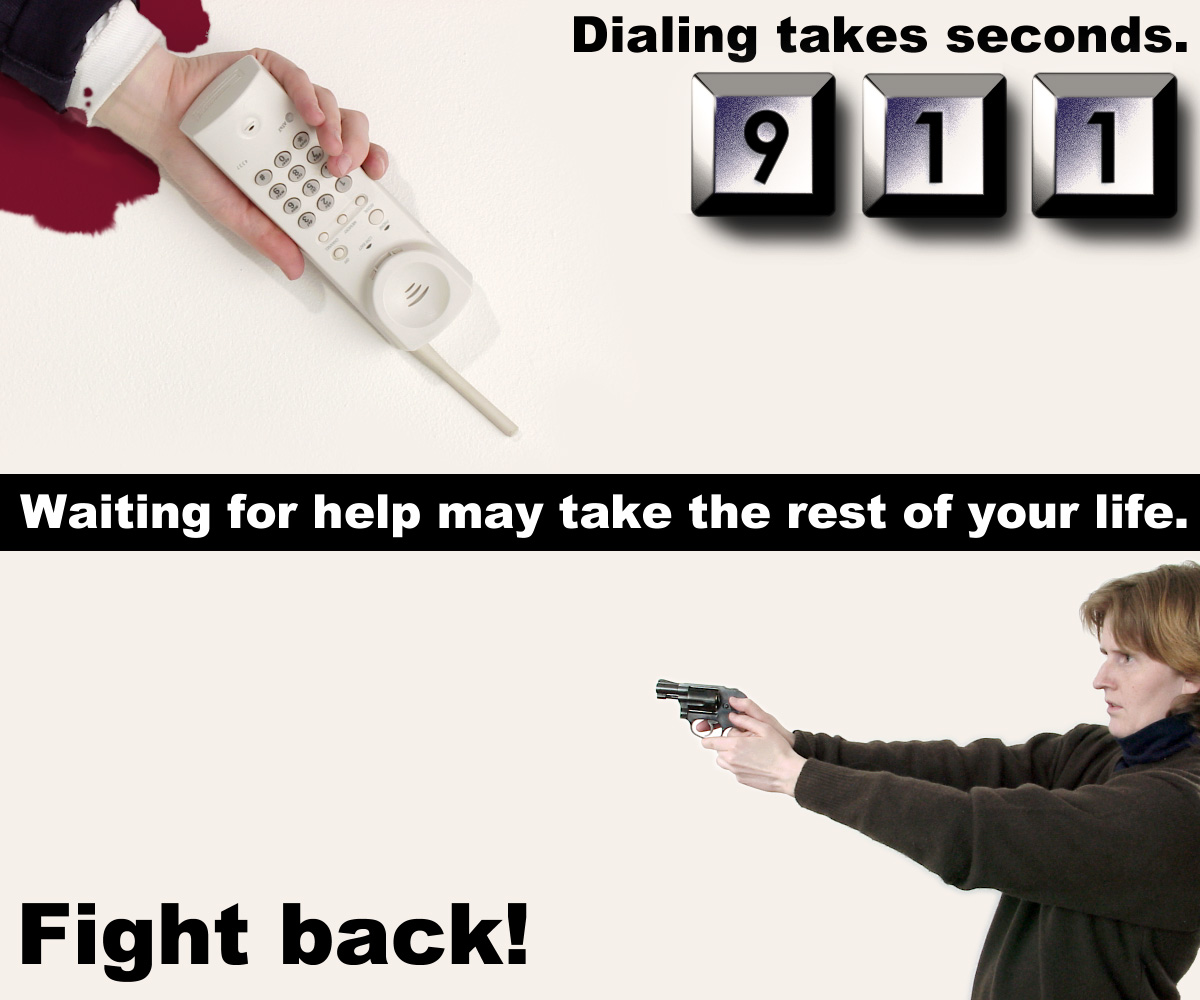
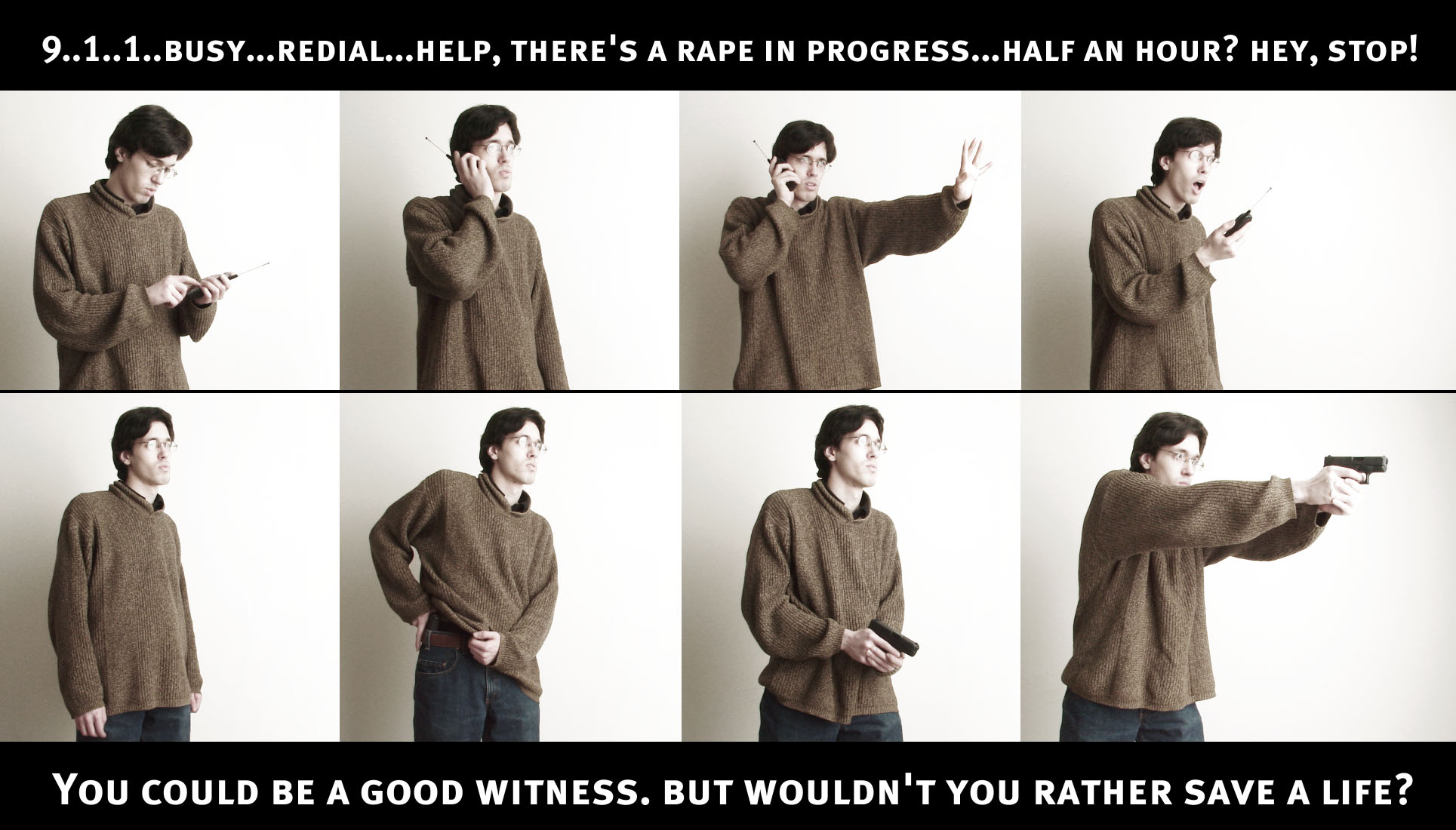
When a threat to your safety comes from a hostile human, it is unrealistic to expect that an assault would be postponed long enough to let you call for help. "Excuse me, Mr.Attacker, I need to call my local police officer and ask for his presence." Right.
Sometimes avoiding a criminal attack is not possible. Fortunately, elementary precautions enable us not to become helpless victims of such attacks. Consider being armed a form of immunization.

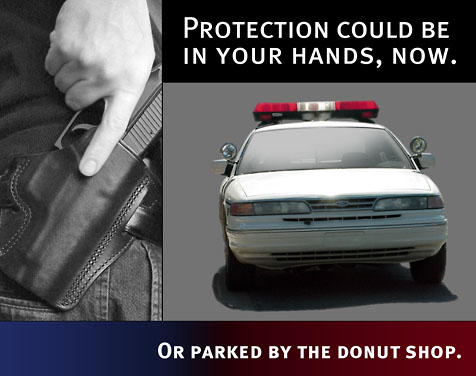
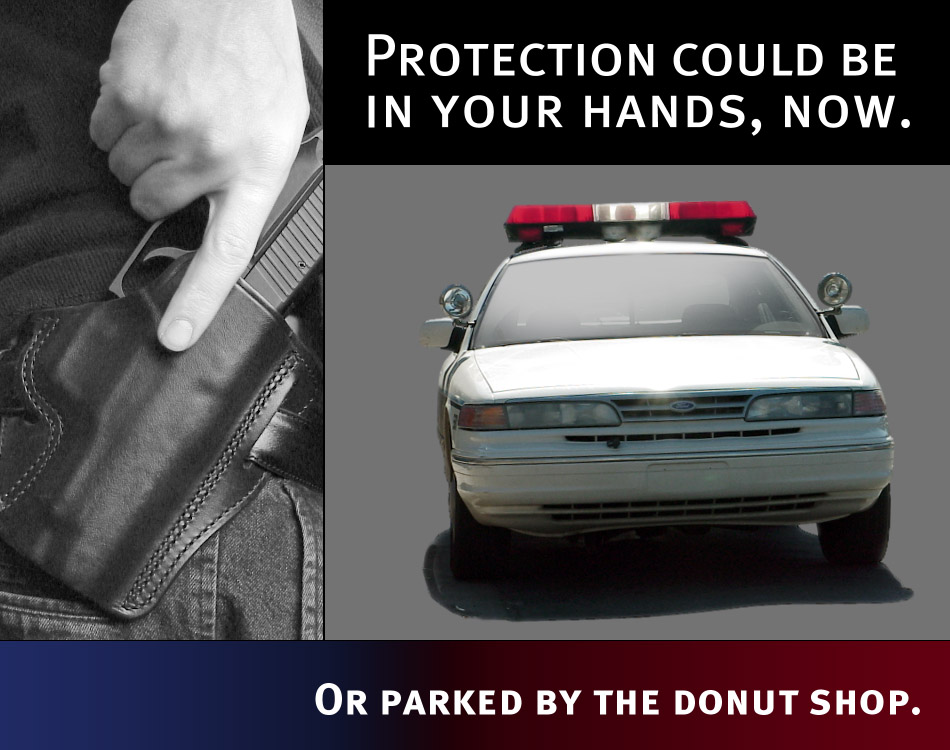
Hi-res In the event that you do manage to ask for help, your savior may be too long in coming. When the source of danger is right next to you and the police cruiser starts from ten miles away, it isn't likely that the cops would do more than take in evidence. Counting on your neighbors is far from certain, either. Kitty Genovese and many others have learned the hard way that bystanders dislike getting involved in confrontations between strangers.
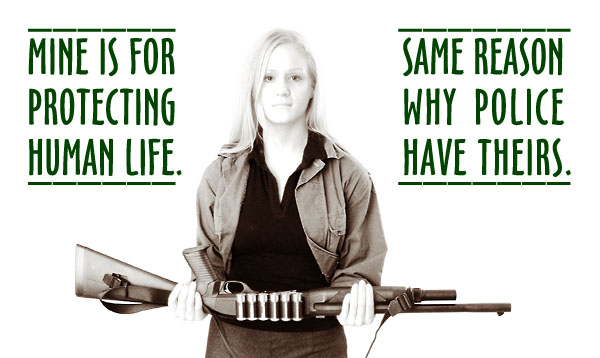
Police officers know that they cannot protect us at all times. That is why most of them recommend that people get the training and the tools for protecting their own lives.
Protection in your hands
Hi-res
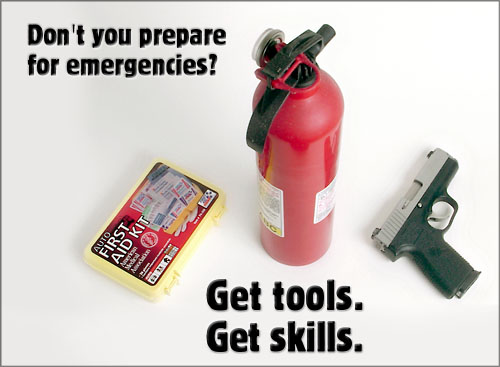
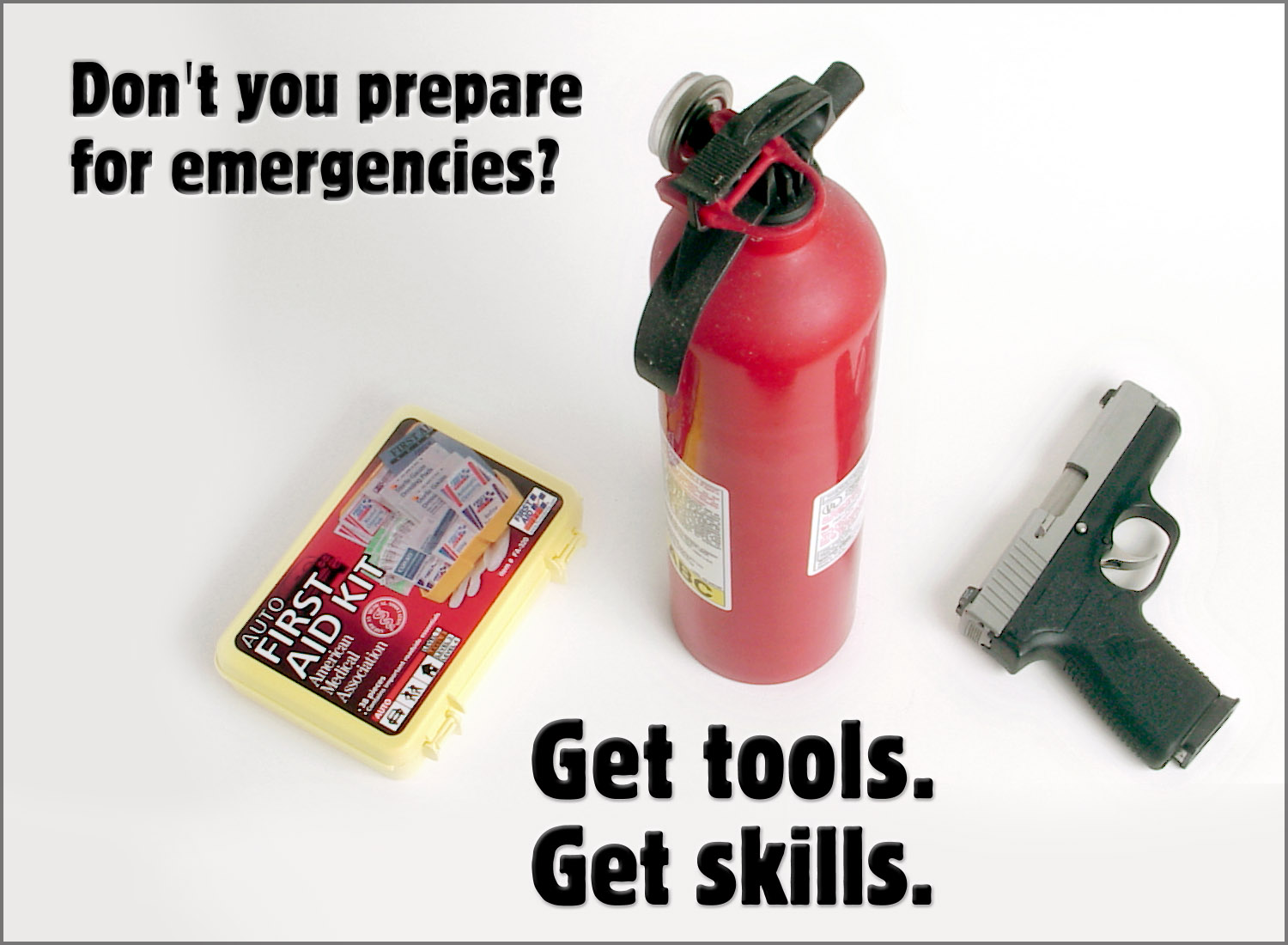
Plan for emergencies Hi-res
You do have a first aid kit in the house, don't you?
Reasonable people have smoke alarms, wear seat belts, buy insurance. They plan against the eventualities of life. No one looks forward to calamities, even if they would validate the necessity of the preparations. Likewise, people who get arms and training wish to avoid situations in which they would become necessary.
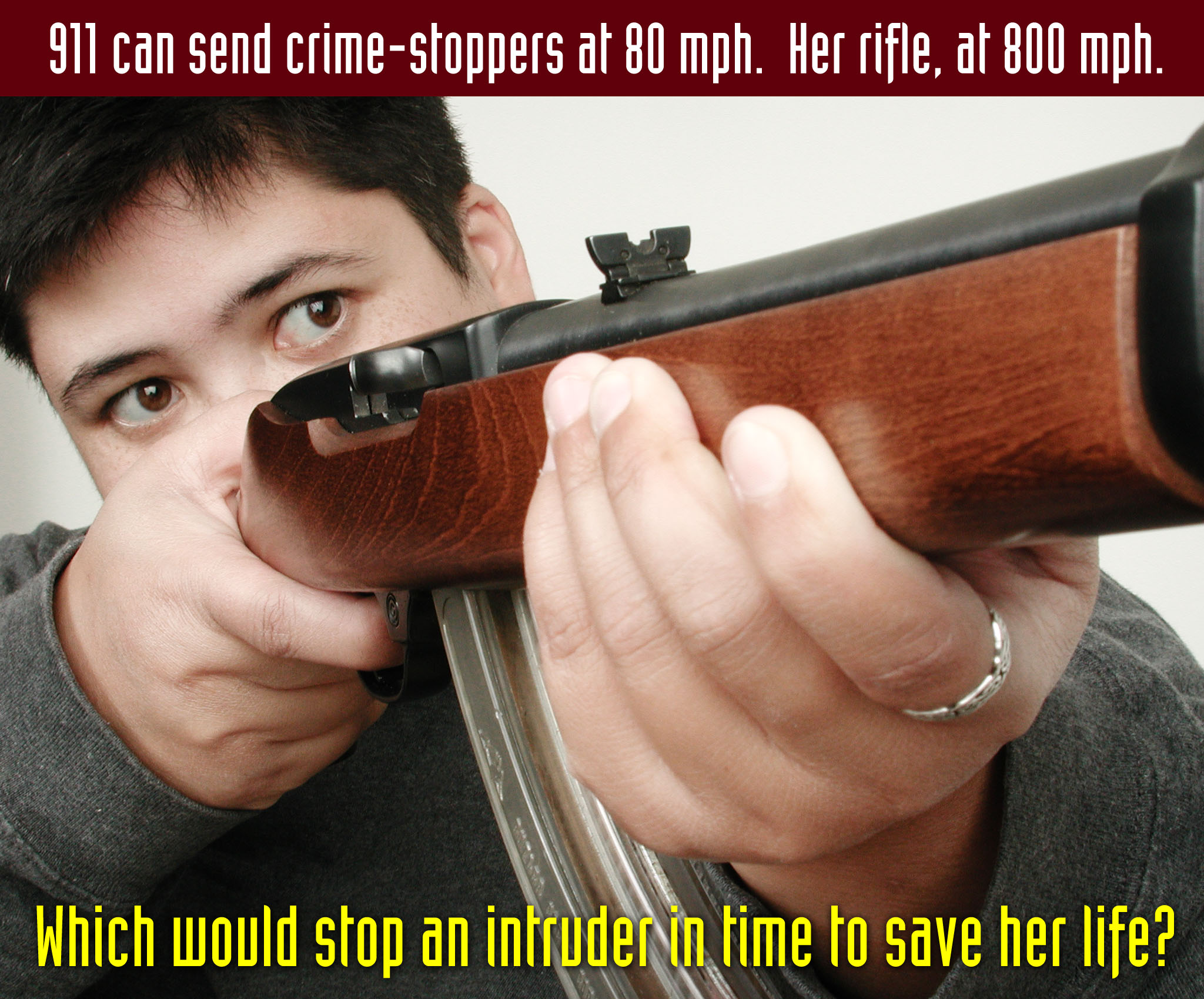
She can protect herself faster
Hi-res
Don't just wait
Hi-res
Be responsibleHi-resSome people wouldn't pick up arms to defend themselves even if presented with such a choice in the hour of need. They do not wish to use force because they feel that it makes them into barbarians just like the attackers. In my view, they are missing the difference between initiation of violence and using force to stop violence.
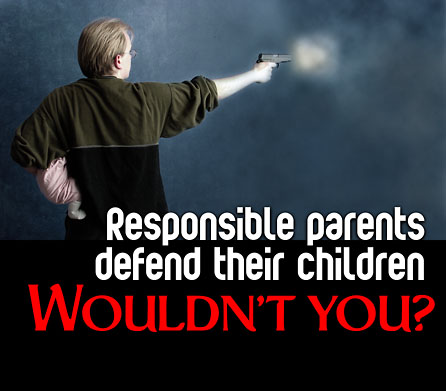
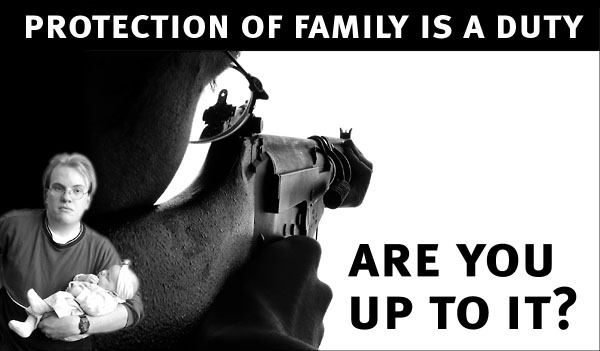
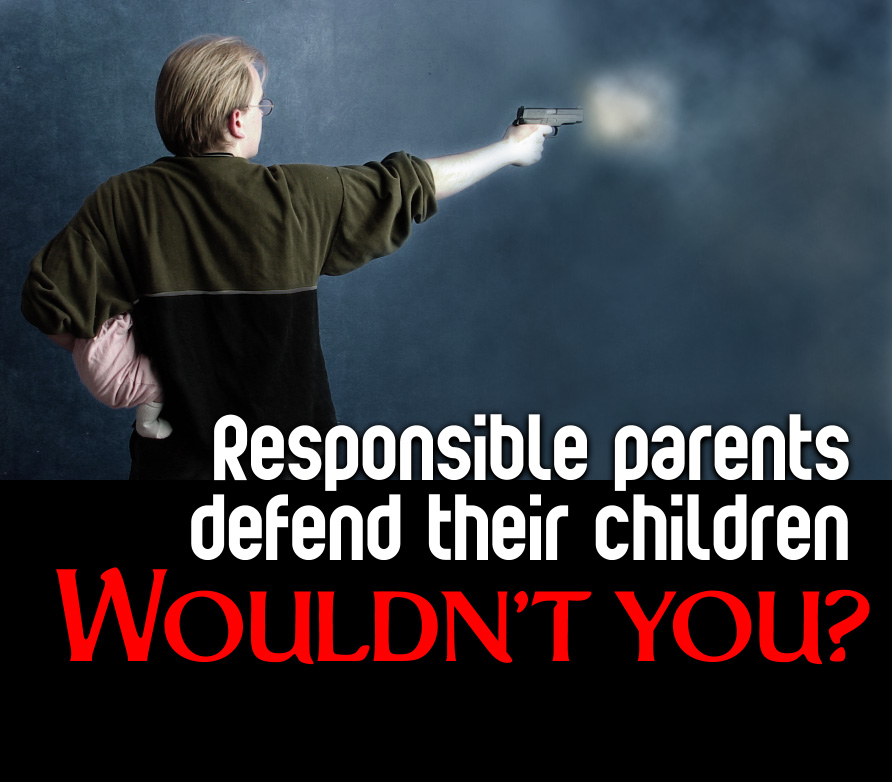
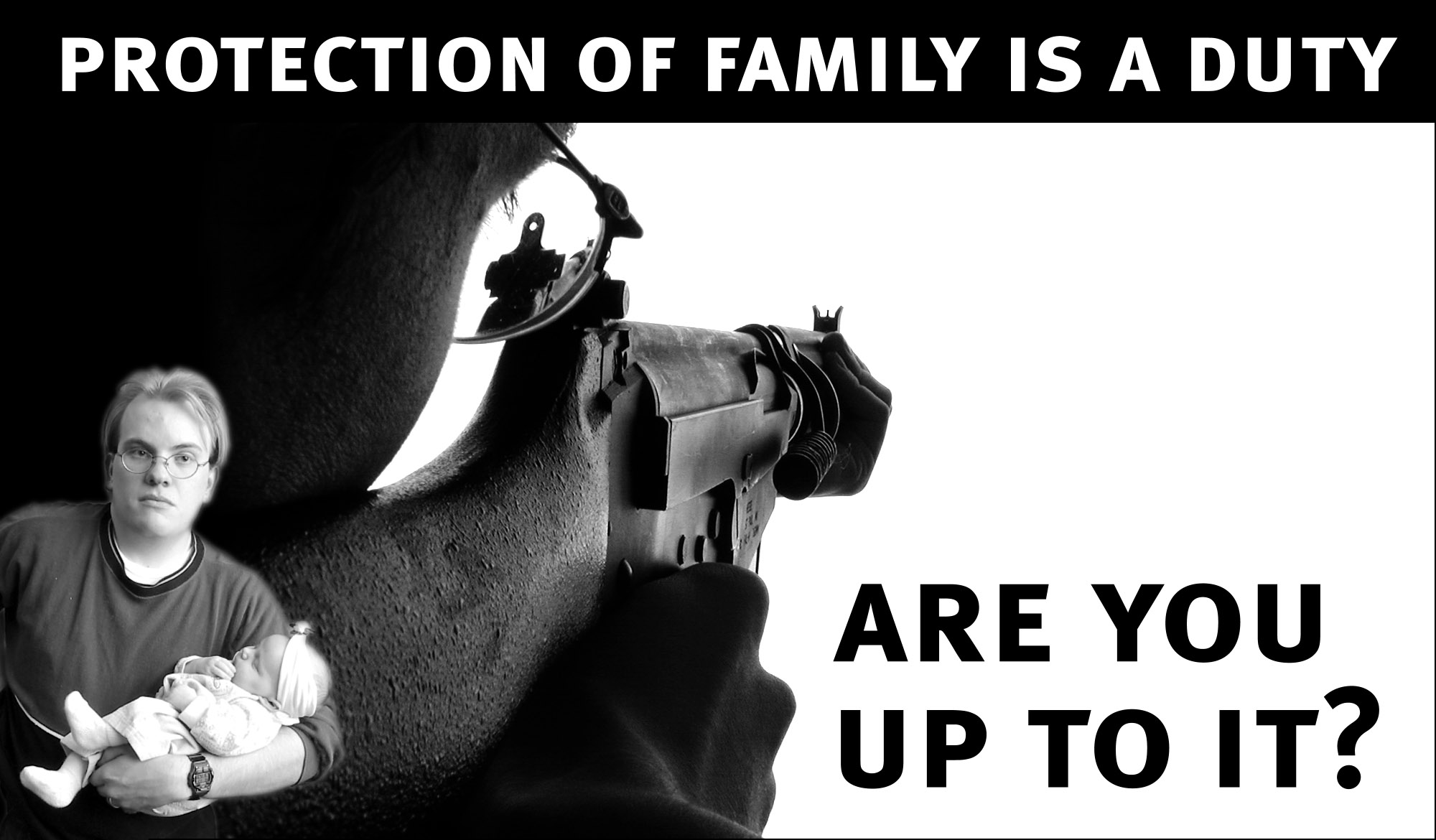
Some of the people who would be willing to perish rather than fight change their minds when the lives of other innocents are at stake. Parents have an obligation to their children, spouses and friends to each other. Yet efforts to protect family members are likely to fail if the protectors have neither tools nor training with which to save lives.
Do your dutyHi-resSome say: "I would not use a weapon even to protect my family." These same people have no problem with calling in police officers who carry guns; and who would shoot criminals to terminate attacks against innocent people. For some reason, they have no objection to deadly force so long as it is used by a uniformed agent of the state.
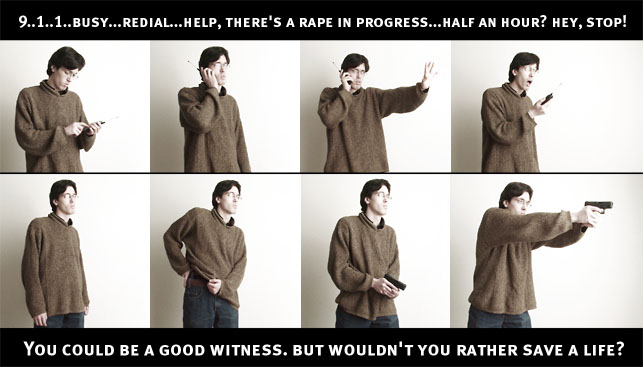
Help or watch?
Hi-res
A gun gives you more options Hi-res
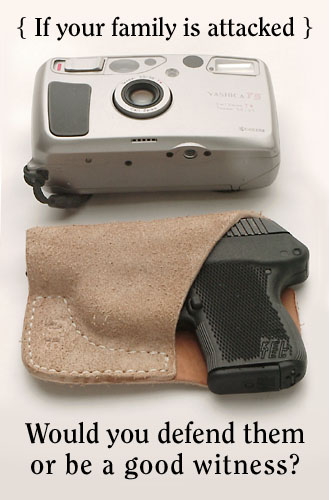
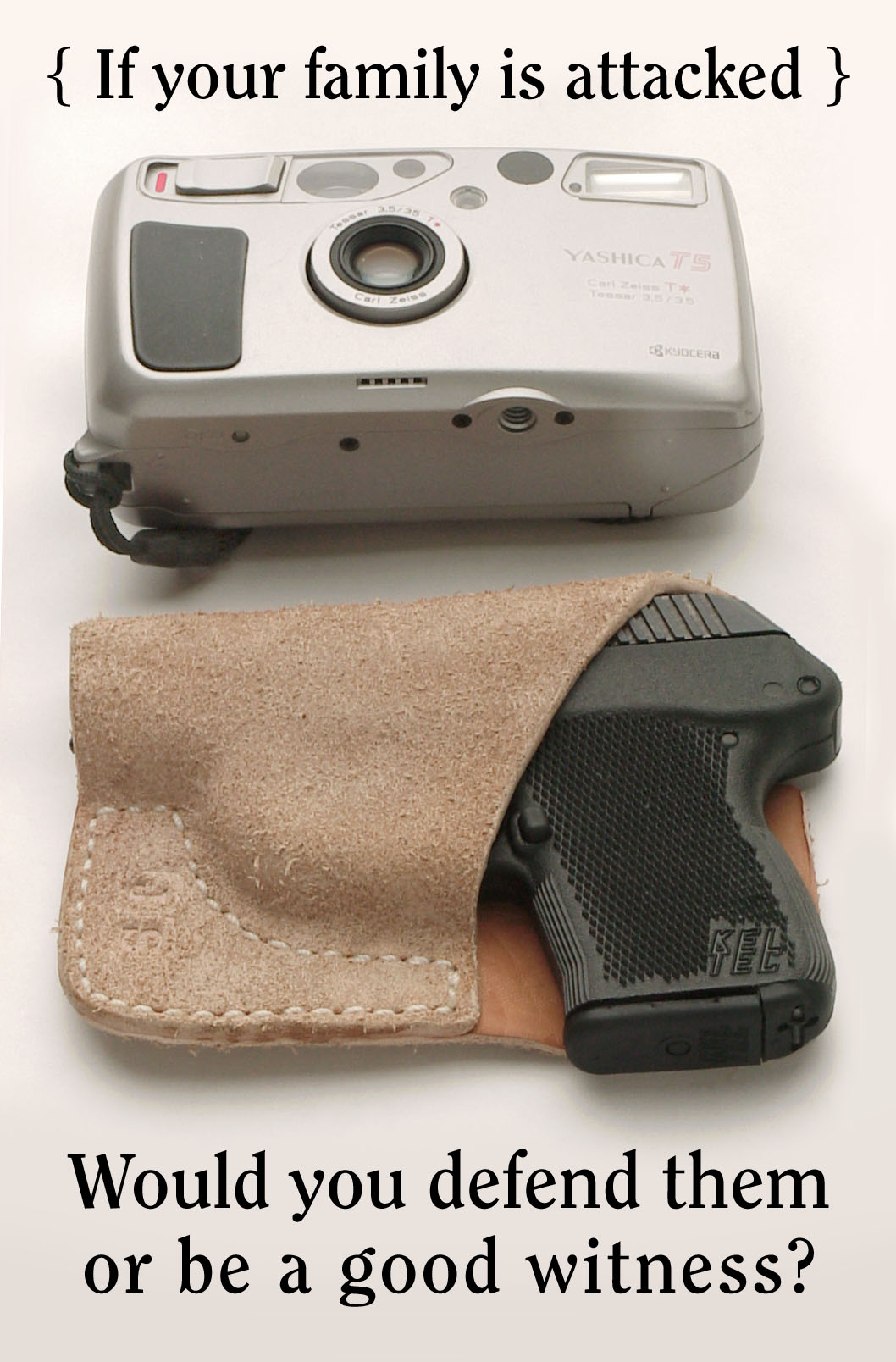
How many times have you heard: "If accosted by criminals, give them what they want and be a good witness"? Do you think you can be an observant, impassive witness if your family or friends are under attack? Wouldn't you rather have an option to render assistance?
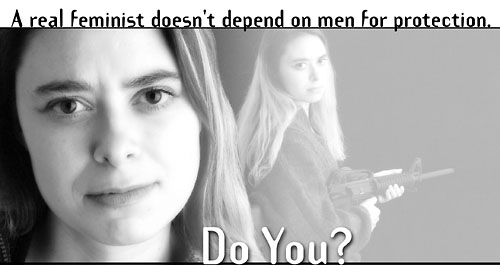
depend on others?
Hi-res
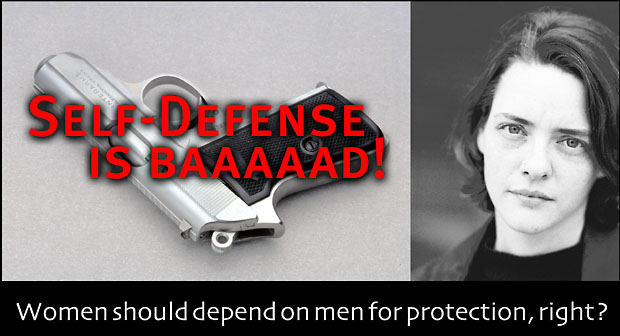
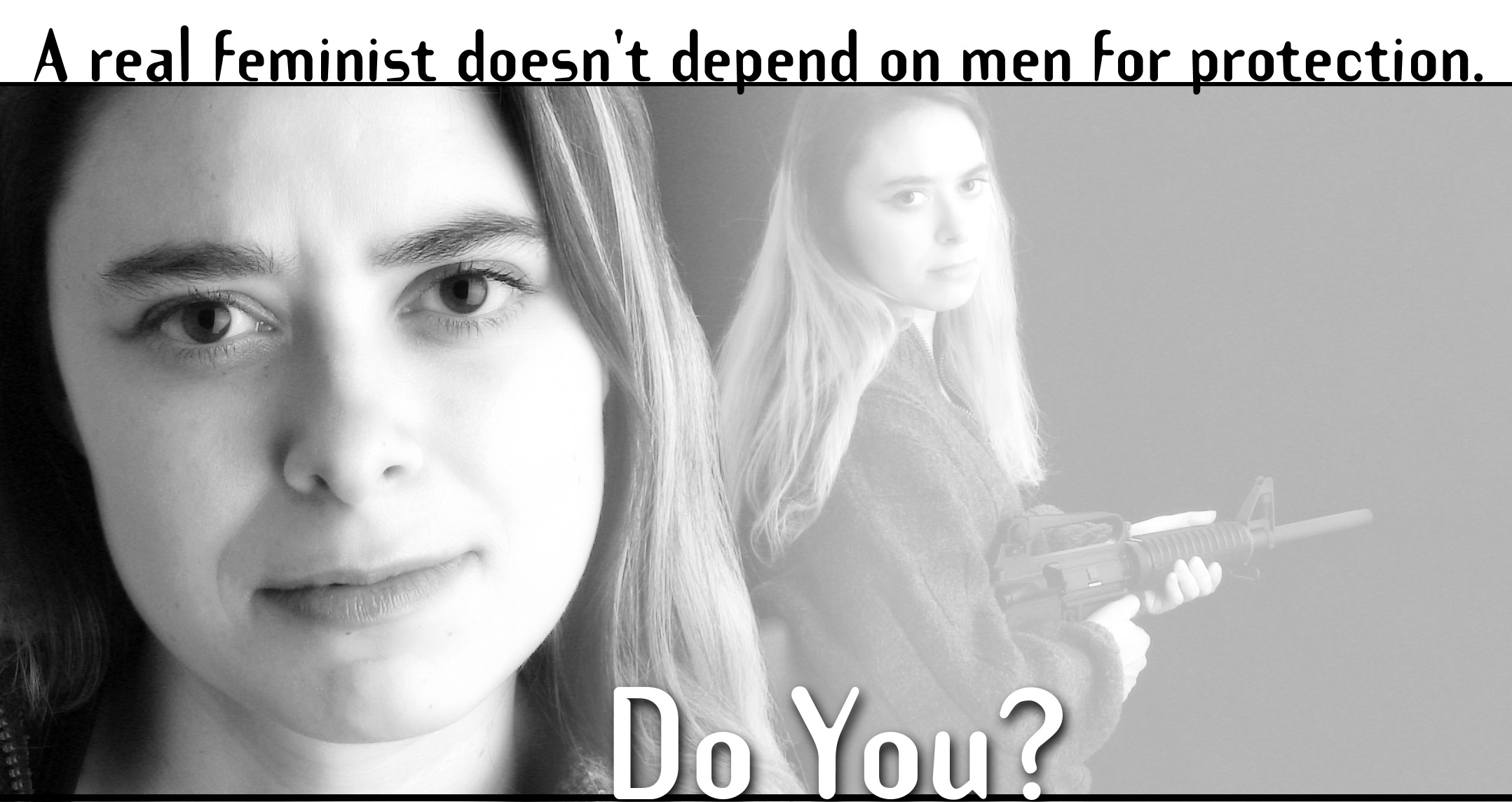
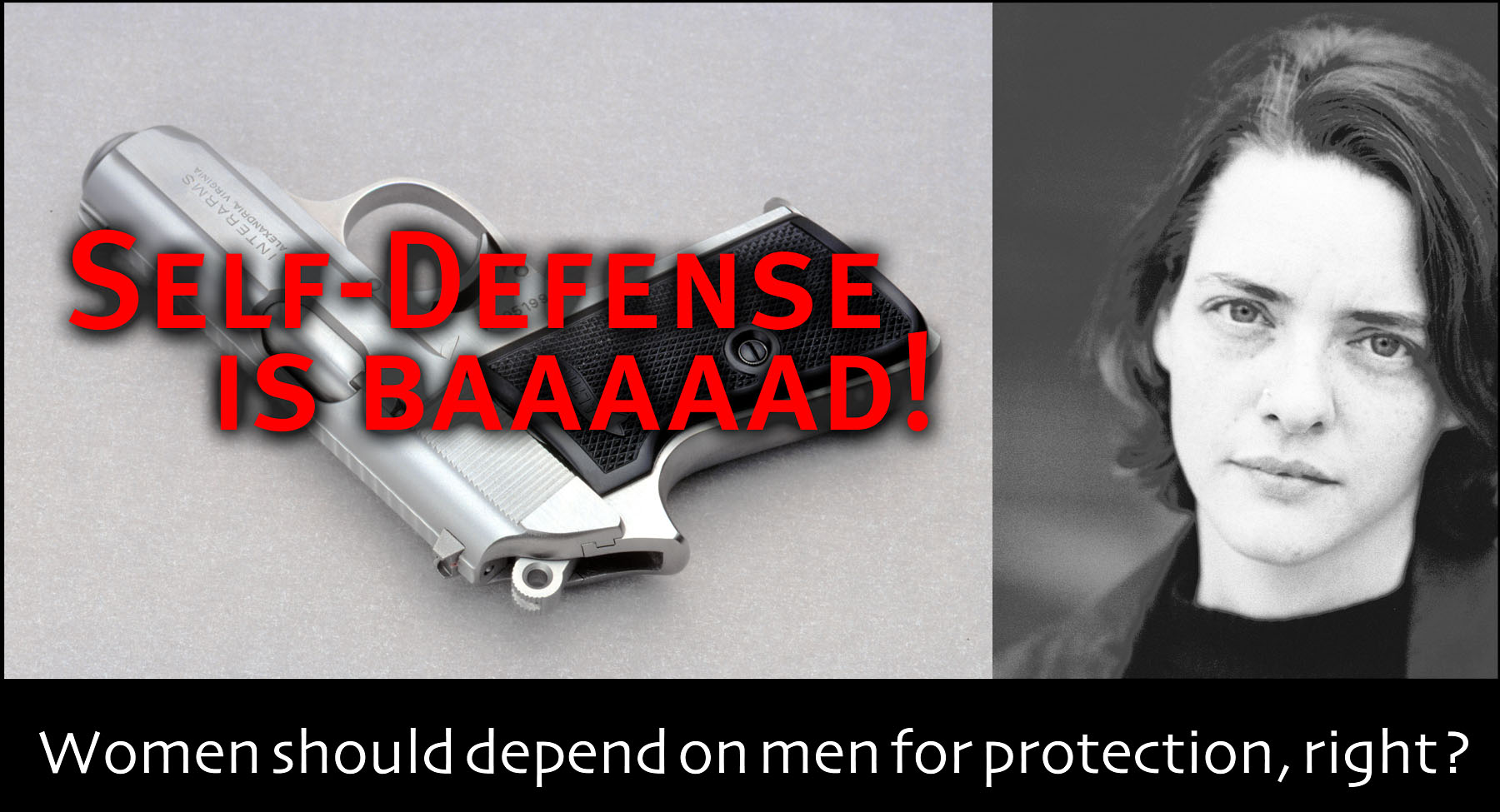
Rely on men or fend for myself?
Hi-res
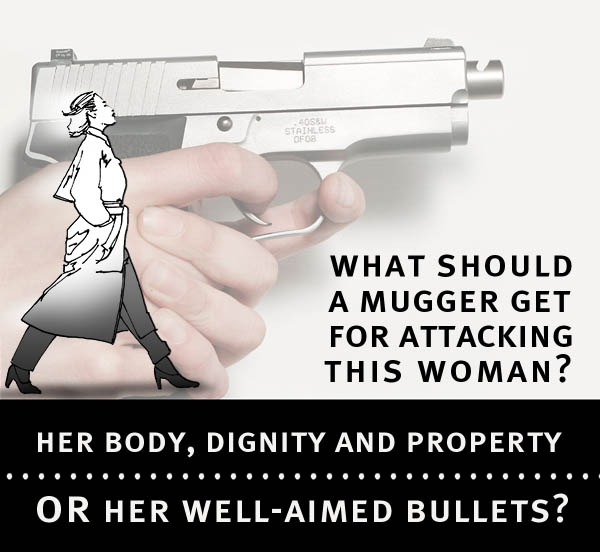
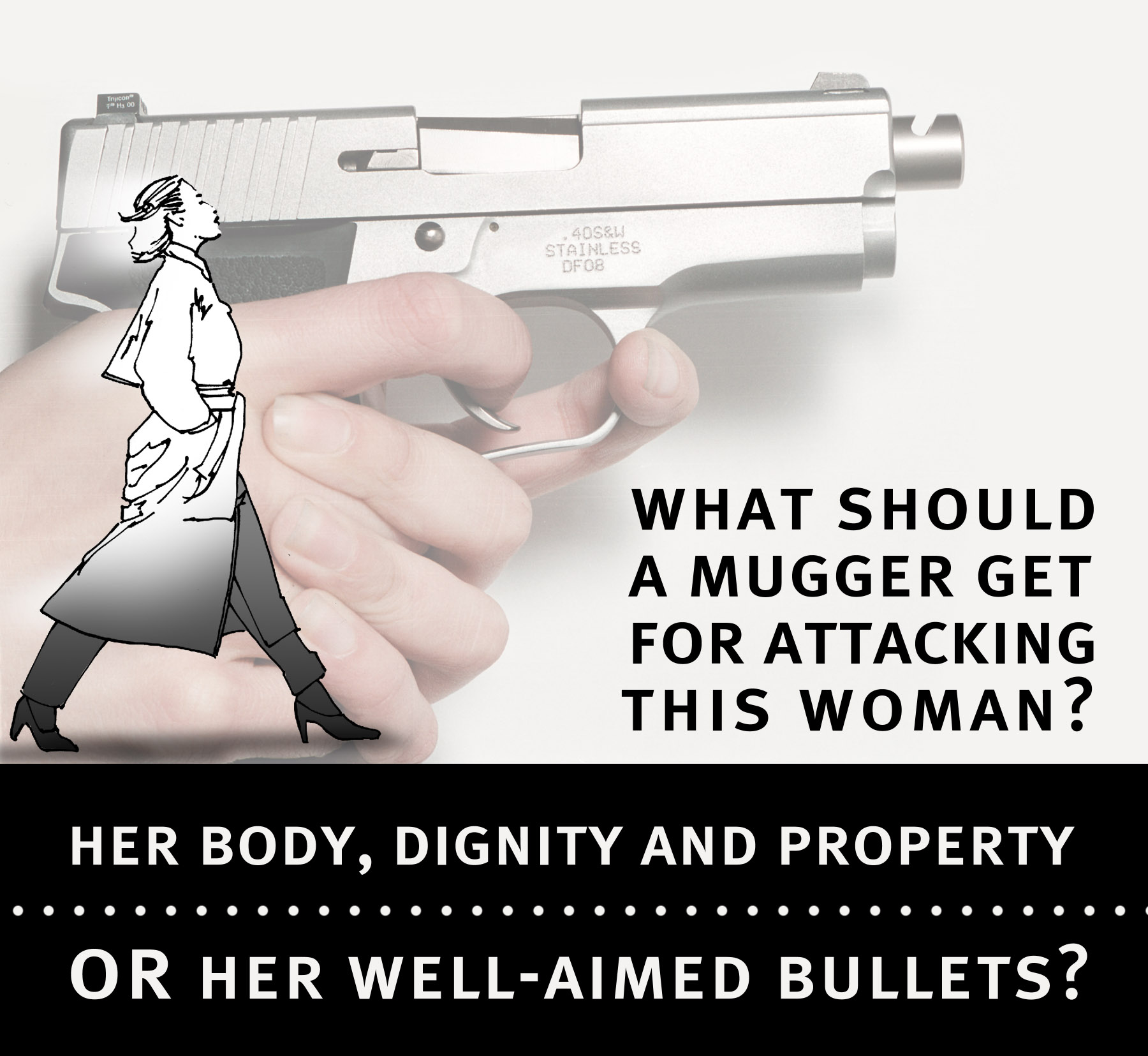
what should mugger getHi-resIronically, some people who loudly proclaim their self-sufficiency deliberately avoid being able to protect themselves. They regard that ability as a trait peculiar to their oppressors, weapons as a hallmark of uncivilized savages. Some even state that they consider being a mangled, abused corpse a more dignified state than resisting with a gun. Do you think that is a logical position?
Giving up, surrendering to evil is not a guarantee of safety. On the contrary, it encourages criminals to attack again. It is like throwing hamburger into shark-infested waters: conditioning predators to expect easy pickings at your expense.


"A man's home is his castle" stated English Common Law.

Americans can protect themselvesHi-res"A man's home is his castle" stated English Common Law. The tradition of respect of safety in our own homes is all the more enduring for our ability to reinforce it. Americans have less concern than citizens in other countries about suffering a forcible home invasion. The reason for that is simple: predators who would break into an occupied home are very likely to be shot by the residents.
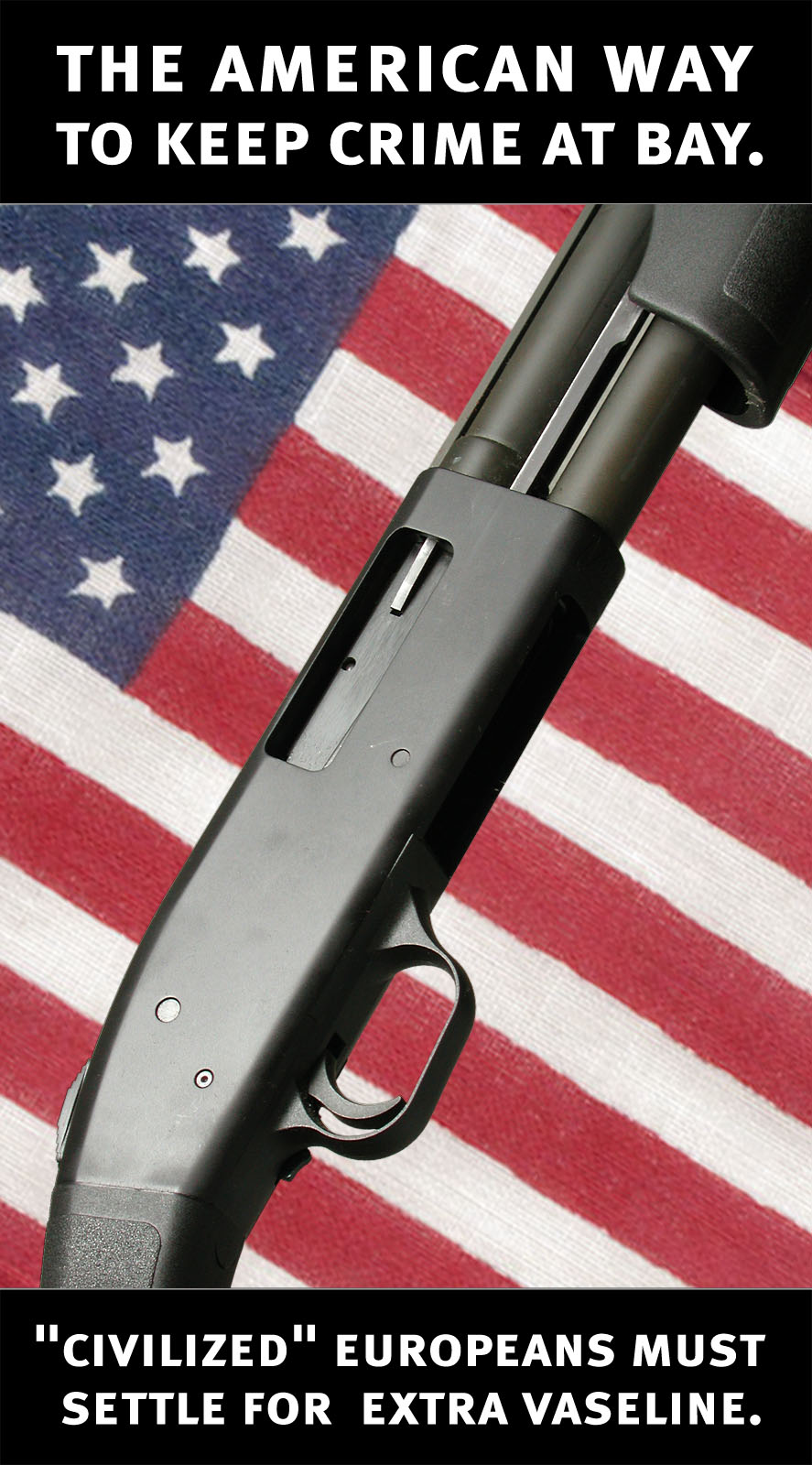
In other countries, especially those which have recently outlawed armed self-defense (such as England), home invasions are on the rise. Their criminals have nothing to fear from the law-abiding people.
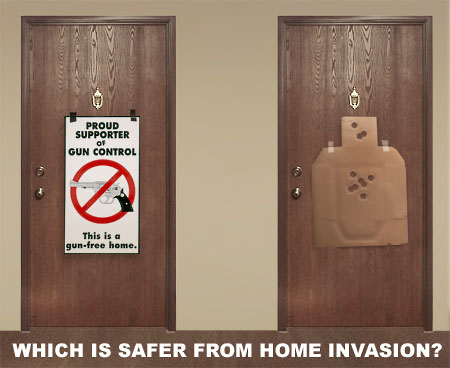
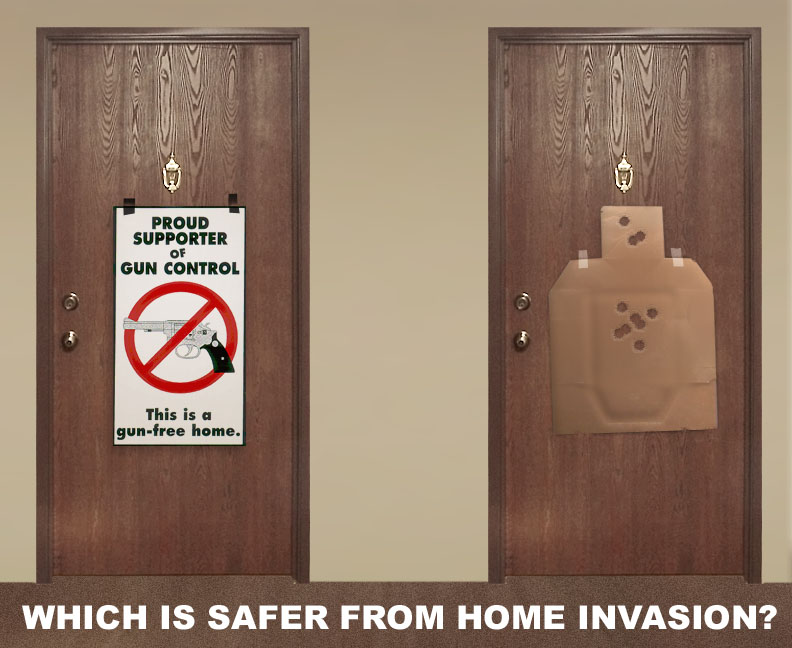
Which door would a burglar pick?
Hi-res
Again, the inability of the predators to divine which house would be easy pickings and which would be defended effectively improves the safety even of those who would not keep arms for protection. An invader can't tell if you, your neighbor, both of you or neither of you would be equipped to end his criminal career on the spot. For that reason, burglars generally try to avoid contact with their victims.
Can't reason with perpsHi-resMany lawful people say that they would not shoot even a criminal in order to protect their posessions. However, we have no way of reading the minds of those who break into homes of other people. They may be after loot, or they may be intent on doing damage to any people they encounter.
Some predators rely on surprise and superior numbers to effect home invasions. Such perpetrators must be repelled, as they often combine burglary with diversions such as rape and murder. Reasoning with them, pleading, appealing to their better side does not work.
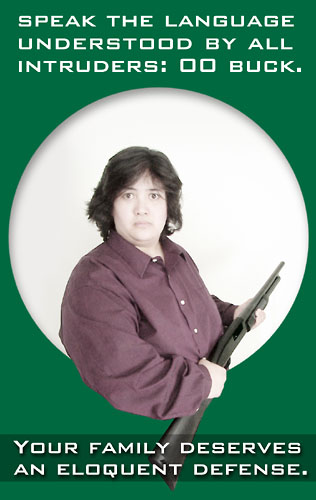
Your family comes first
Hi-res
Strong response required Hi-res
Breaking into somebody's home is not an accidental act. A burglar who has no regard for the sanctity of your home would likely have no more regard for your physical well-being. With that in mind, please place your own safety first and foremost in your mind.
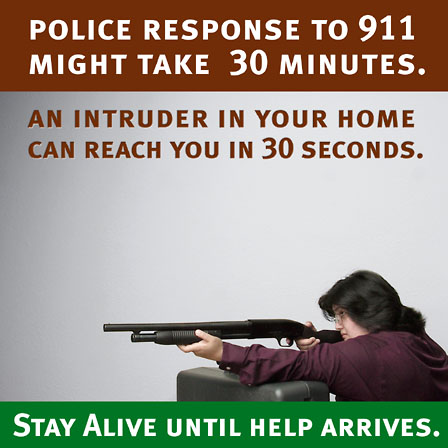
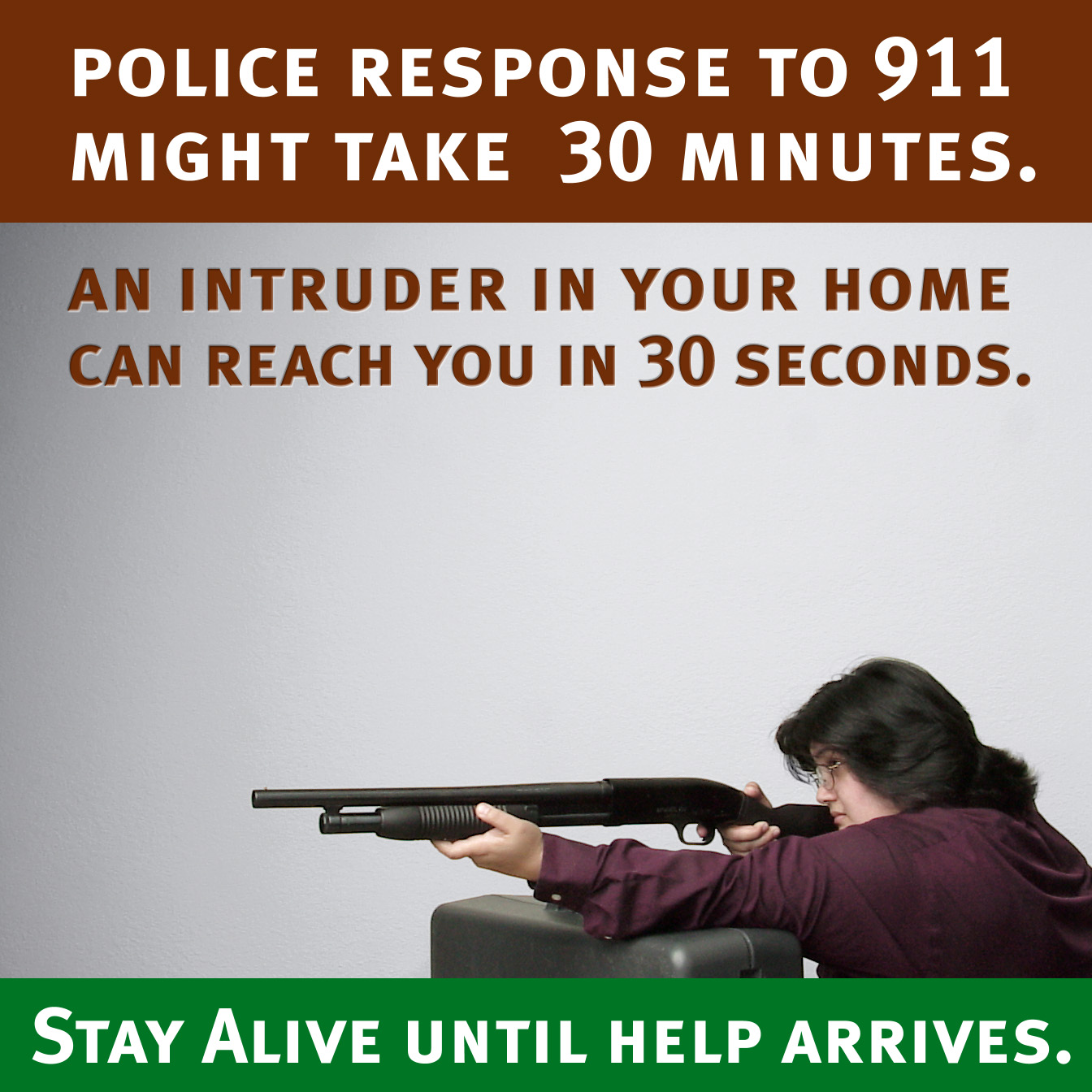
Stay alive till help arrives
Hi-res
Stops intruders Hi-res
Your goal is to survive the invasion until cops show up in strength. Going to look for the intruder would not be safe. Make sure that you have accounted for all family members, then stay put in the safe room and cover the door with your weapon. Any damage visited upon the intruder would be his own fault.
When your back is to the wall
Hi-res
Would your spouse help? Hi-res
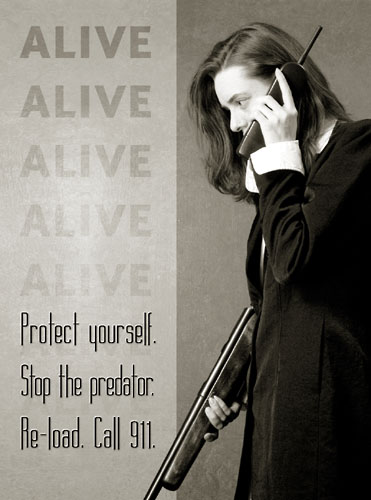
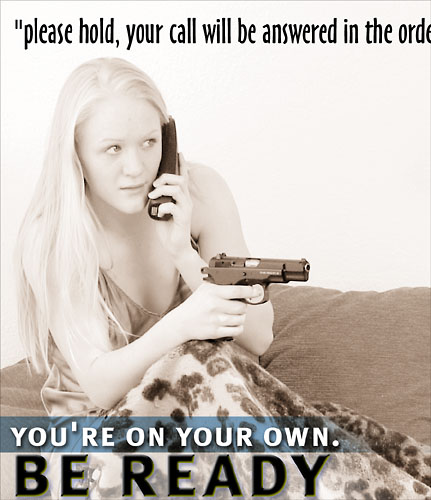
Situations like this are one of the reasons why having more than one trained person in the family is helpful. You might be on the phone with police and distracted, but your spouse would cover you. Hopefully, the 911 emergency dispatch system would work well when you need it. In a city, police response may be rapid, but out in the country you may wait for an hour before help can get to you.
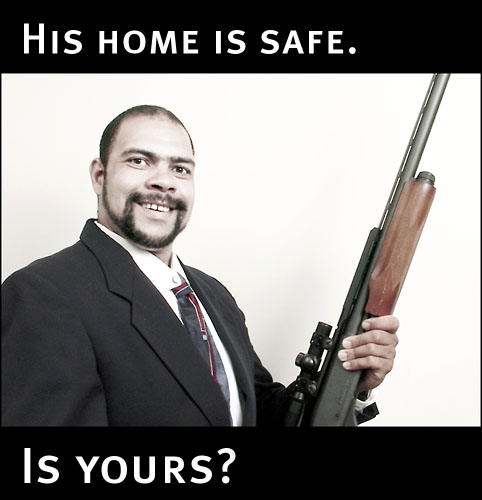
Stay aliveHi-resHis home is safeHi-res
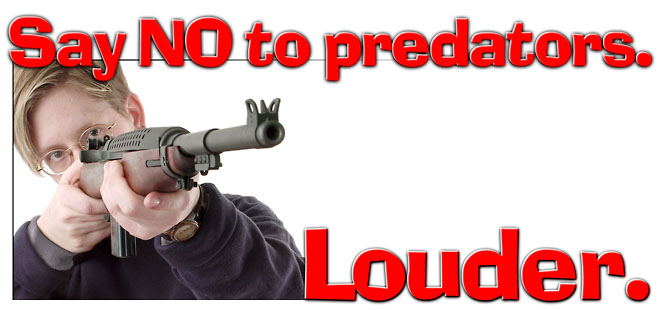
Effective measureHi-resSay NO to predators Hi-res
Pointing a gun at somebody is not very nice but neither is breaking into people's homes. Furthermore, use of any less effective means of self-defense plays into the hands of the criminal. That isn't noble, merely stupid.
Fortunately, most burglars won't dare to loiter once they realize that they have been spotted. They are in for the easy pickings and not for ending up between armed homeowners on one side and police on the other. On the other hand, if they suspect that the residents are not armed, they would attack at once to prevent a call for help.
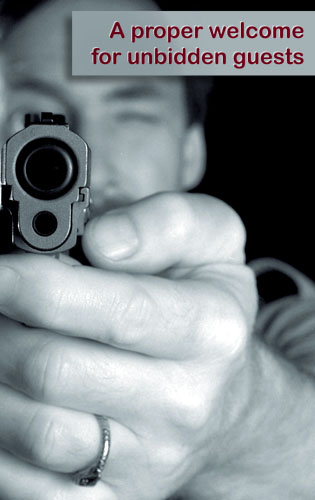
Proper welcome for perpsHi-resBe ready
Hi-res
Good defenseHi-resFor saving lives Hi-res
"But how can you set yourself as jury, judge and executioner?" some would say. "Even criminals deserve a fair trial."
If a person must fire on an intruder, she would be doing so only in order to protect lives of self and dependents. Not to punish, not to discourage criminal behavior but to save lives from a predator. As a side effect, being shot in the process of committing a crime provides potent Pavlovian conditioning to the perpetrator

Why have real guns?

Why have real guns?


For the first sixteen years of my life, my experience with shooting was limited to single-shot pellet guns at arcades. The USSR, my former country of detention, did not permit mere subjects to have arms. New York City, my family's first residence in the United States was scarcely better in that respect.
Although I always had an interest in military history, the idea of having weapons of my own was quite foreign to me at the time. In 1990, a year after my arrival to the United States, I lived in Urbana, IL. My neighbor, an elderly Jewish gentleman, let me fire about thirty rounds from his Marlin 60 and I was hooked. That man, by the way, came from Russia in 1905 with his grandfather. His family wanted to escape pogroms. It did not register in my mind until later that a shotgun and an autoloading rifle were always in his den, both loaded.
The next day my father and I went to the local Fleet Farm and bought me the cheapest BB gun they sold. It cost $24.95 and represented a very lavish purchase given the state of our finances at the time. Later that day I found out that nowhere except on our friend's property can I legally shoot the BB gun. Not knowing the laws all that well and afraid of consequences, I returned the BB gun to the store.
Calving and Hobbes meet Star Trek
Hi-res
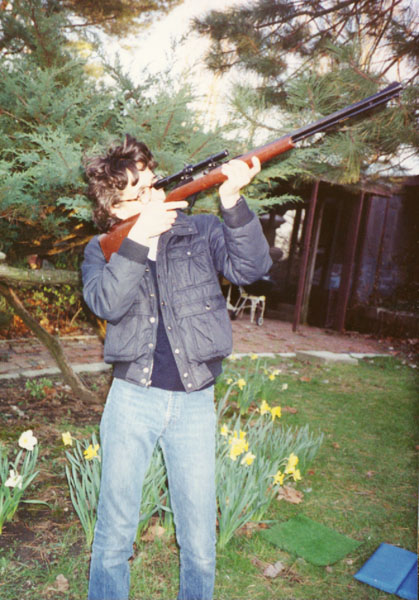
The next few years passed with me reading about guns but never considering owning them. While in high school in Minnesota, I parroted the local pravda's assertions that guns and gun nuts were bad even as I had photos of myself with other people's guns. I sent those photos to relatives in Russia so they could see how free I was.
When I was sixteen, a police instructor taught me and my parents the basics of firearms safety. I enjoyed the learning tremendously but came away thinking that guns were noisy, expensive, too complex to re-assemble after cleaning. Moreover, I did not know of shooting ranges and thought that I'd have to know people with land in order to practice.
Somewhat later, I started getting concerned about gun control. If history was any indication, unarmed populations generally fared very poorly in the face of any adversity. Knowing myself to be a lousy shot, I started this web site, a single page entitled "Life Insurance" back then. The purpose was to convince others to get armed and trained.
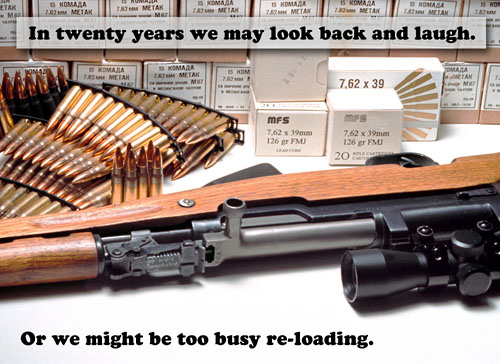
In 1997, my girlfriend was being stalked. At that time, I had borrowed a .22 pistol from a friend and practiced with it. That gun became our only defensive weapon. Some time later, I was riding to work with another designer and she asked me if I heard the news about the import ban. Turns out that the availability of weapons was about to decrease further yet. That evening I came home with an SKS rifle, a bag of stripper clips and all of the 7.62x39 ammunition that the store had, about 320 rounds in all.
What I would have much preferred at the time was a single-shot arcade style pellet gun. I was no fan of the noise, the recoil, the range fees, the cleaning involved in the ownership of a real rifle. Add to that the lousy accuracy that a tyro like me had and the abject pain I felt parting with my hard-earned and scarce money...I would have preferred a cheap BB gun.
Daisy air gunMak90 rifle
So why did I buy a weapon instead of a toy for sport? The motivator was the realization that I may not have the choice of getting armed soon. The knowledge that people who wished me disarmed would have no trouble taking an air gun. I knew that my rifle skills were poor but hoped to do well enough at ranges not exceeding the length of the hallway.
Other guns followed later. It was only after I acquired combat weapons that I allocated money for sport, mainly with training youngsters in mind. I now own the same cheap BB gun that I had once wanted. I fired it once, for sentimental reasons. The point of this long-winded story is that I would not have become a gun owner had it not been for the people pushing gun control. They can be proud of themselves for they supplied the motivation for yet another American to get armed and trained. I do not think they quite understand that once armed, a free man cannot be disarmed, only defeated.
A toy and a weaponRifle, seven magazines, a smile
I do not hunt. I do not compete. I do not collect for the sake of having interesting objects in my posession. The only reason why I own guns is, according to the BATF, not sporting. Self-defense is the one use that our government does not view as legitimate...an attitude that is quite disturbing in the people who are supposedely employed by the taxpayers. I can only wonder what they are up to that they prefer people around them to be unequipped to resist aggression.
Over time, I have introduced quite a few people to firearm basics. I have given guns as gifts to people whose lives were especially precious to me. Back in Russia, I was born too late to make much difference. Here, in the land of the free, I hope to influence the outcome of the population control end-game one training session, one web page or, in an emergency, one round at a time.
Hi-res
I was asked once why I put so much importance on pieces of metal and wood. My friend Dennis Bateman answered that question very eloquently. The artifacts we use do not much matter: the values for which they stand matter